Killeany / Cill Éinne St Enda's Monastery, High Cross, Cross slabs, and Bullaun stones Throughout the late fifth and following centuries Early Christian monasteries were established on almost all of the islands off the west coast of Ireland. For a number of years, either together or separately, myself and José have visited the vast majority of these Early Christian foundations, I will mention a few of them here starting from north to south with Tory Island and Inishkeel in Donegal to Inishmurray in Sligo, Inishkea North and Clare Island in Mayo, Inishbofin and St MacDara's Island in Galway to Scattery Island on the Shannon Estuary, County Clare to Illauntannig and Church Island (Valentia Harbour) in Kerry. Without doubt the island with the largest concentration of Christian monuments is Inishmore, it has a vast wealth of Early Christian and medieval monuments, over twenty churches have been recorded on the island. The two principal Christian sites are Temple Brecan, aka The Seven Churches-na Seacht Teamphaill at the west side of the island and St Enda's monastery at Killeany-Cill Éinne at the east end.
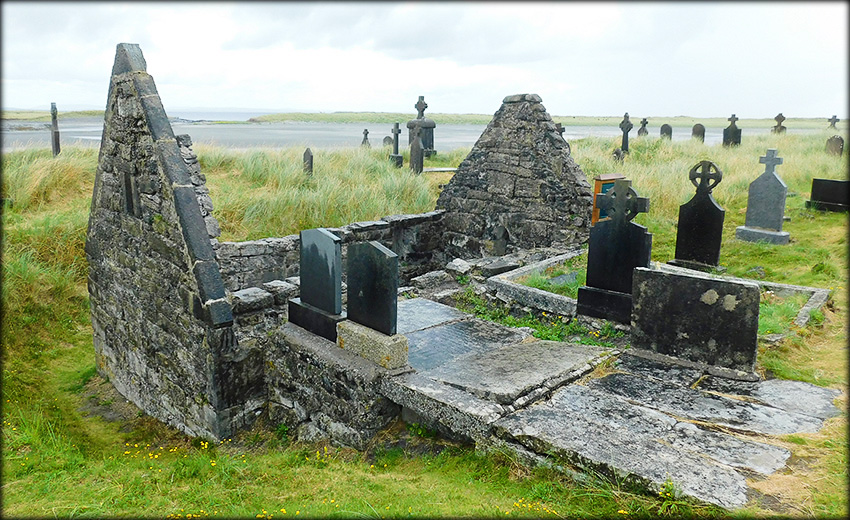
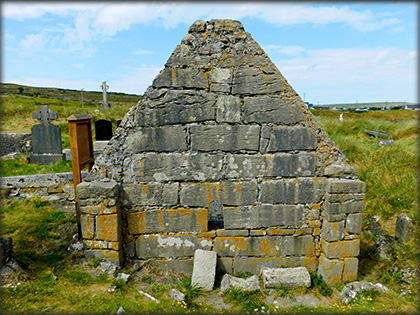
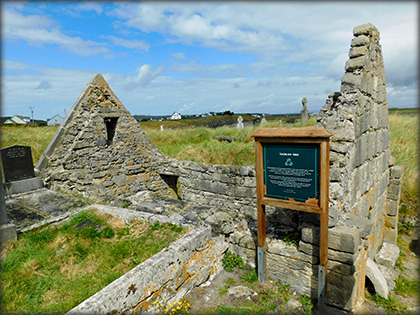
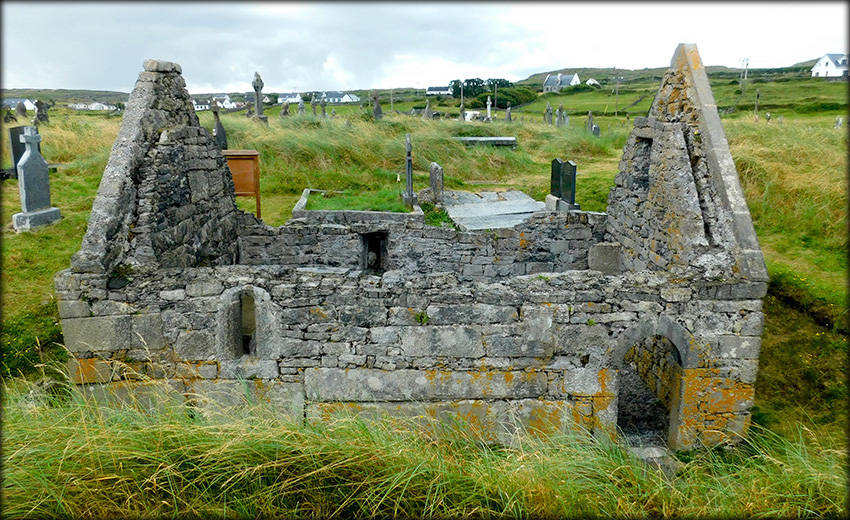
In the late 5th/early 6th century St Enda established an Early Christian monastery at Killeany, the church was probably located in an area close to the 11/12th century round tower. In the 17th century there were six churches in Killeany townland, but only two of these churches survived, in the middle of that century Cromwellian forces destroyed many of the monuments in order to build the bastioned fort known as Arkin's Castle. The two surviving churches are believed to be outliers of the main monastery. Temple Benan is situated on a rocky plateau to the west of the round tower and Tighlagheany-Teachlach Éinne, pictured above, is situated about 500 metres south east in the graveyard for the monastery. Tradionally it is believed up to 120 Saint's were buried in the graveyard, including St Enda. Tighlagheany Church is just 5.9 metres long by 2.9 metres wide internally and is aligned E-W. The antae and cyclopean stones used in the east gable, pictured below, and lower courses of the north wall point to an Early Christian date. The rest of the structure may be 17th century. It is unsual to find a doorway in the north wall of an Irish church, but this maybe for protection from the elements, because of this sites particular location. |
|
|---|---|
East gable with antae |
South side |
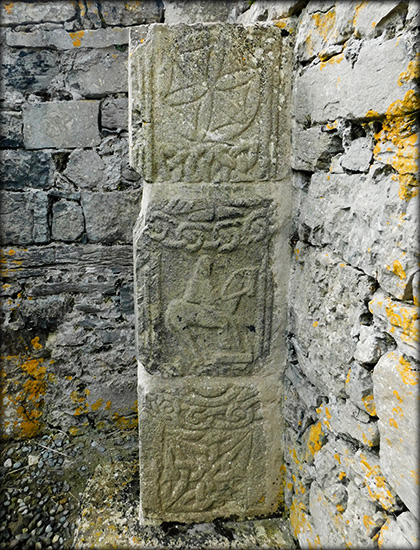
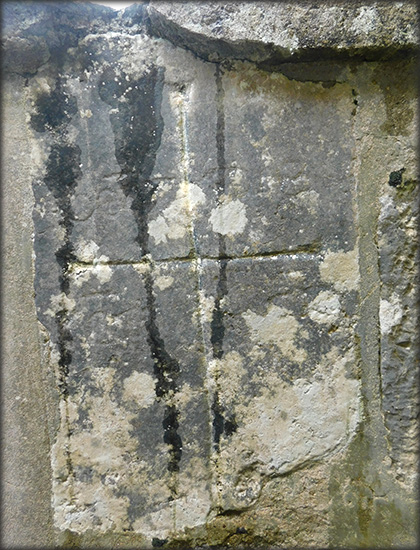
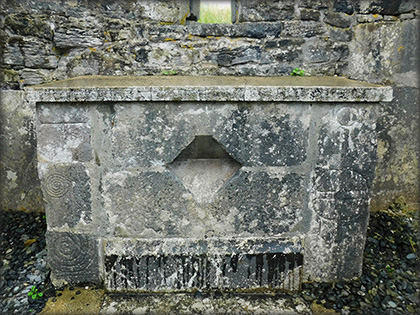
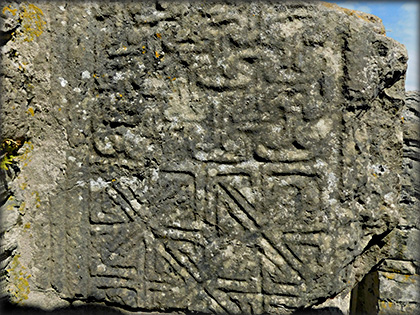
High Cross and Cross slabs Three fragments of a limestone cross, wrongly pieced together, are cemented against the west gable. The south face, see below left, feature a floral design inside a circle at the top, the middle section features a horseman, and top bottom piece has knotwork. the bottom of the south face bears knotwork and the top panel, immediately below left, features fretwork. Fragments of a Cross head are now stored in Killeaney National School-Scoil Náisiúnta Cill Éinne in the centre of the village. It has been suggested that these three fragments plus the fragments of the cross head are all part of the high cross, located near the round tower. At the east end of the church is a modern altar, built into the top of north end of the west face, is the cross slab, pictured below right. It bears an incised latin cross triangular terminals and the following inscription: BEN(DACH)T DIE F(OR) AN(IM) S(AN)C(T)AN. The is another Cross slab built into the south end of the altar, it bears a ringed latin cross with a roundel above the head. It can be seen in the image at the bottom of this page. A third cross slab is hidden below the sand built into the north wall it too bears an inscription reading: OROIT AR SCANDLAN. |
|
 |
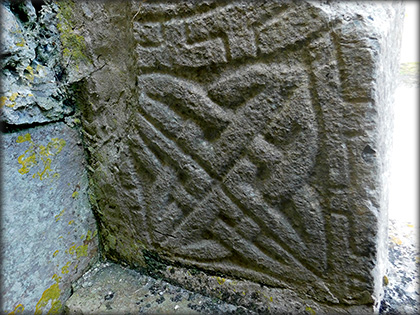 |
High Cross fragments, south face. |
Cross slab, with Latin cross and inscription |
|
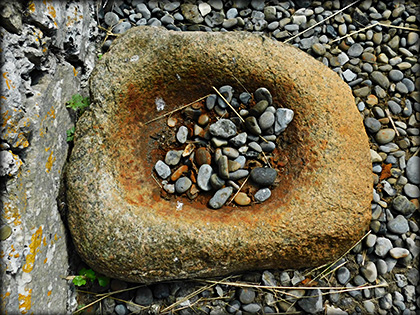
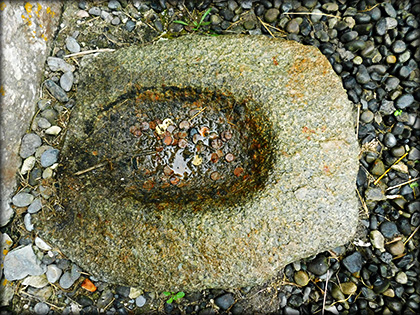
Lying inside the church, against the north and south walls, are the two bullaun stones pictured below. The granite bullaun shown left lies next to the south wall it is 0.56 metres in length and features a roughly oval shaped hallowed bowl. . The other bullaun is also a granite boulder, it is 0.65 metres in length and features an oval shaped bowl, sadly the north end is broken. |
|
Located inside the doorway |
Located close to the south wall |
Situated: In Killeany graveyard about 300 metres south of the village. Discovery Map 51: L 89368 06881. Last visit July 2026 Longitude: 9° 39' 09.6" W Latitude: 53° 06' 04.5" N Photos: José Gutiérrez. |
|
Ref: Manning, Conleth. “Archaeological Excavations at Two Church Sites on Inishmore, Aran Islands.” The Journal of the Royal Society of Antiquaries of Ireland, vol. 115, 1985, pp. 96–120. JSTOR, http://www.jstor.org/stable/25508884. Ref: National Monuments Service website, www.archaeology.ie Creative Commons Licence |
|